
Quilting perspectives
for more just cities
We are an organization operating at the intersection
of social research, law, and public policy.
We specialize in socio-spatial analysis and design,
participatory action research, and public innovation.
We emerge from the convergence of practices in urban commons for civic and collective use, action research and training on the relationship between cities and governance processes and feminist grassroots participation, oriented toward a horizon of social justice.
We design and facilitate pathways that connect institutions, communities, and territories. We collaborate with public administrations, philanthropic foundations, individuals, civil society organizations, and private entities to build capacity among stakeholders, foster inclusive decision-making processes aligned with each organization’s core values, and design care infrastructures that make collective life more sustainable, accessible, and equitable.
Who We Are
- public and democratic participation processes
- transformation of ↗ Social policies, services, and interventions organised at territorial level to respond to community needs, and in particular to the needs of people in vulnerable conditions.
- ↗ The set of processes, relationships, and tools connecting public institutions, private actors, and local communities.
- ↗ Urban spaces, assets, and resources that are not profit-oriented but managed through the use and care of the community, following principles of usability, inclusiveness, impartiality, accessibility, and self-governance.
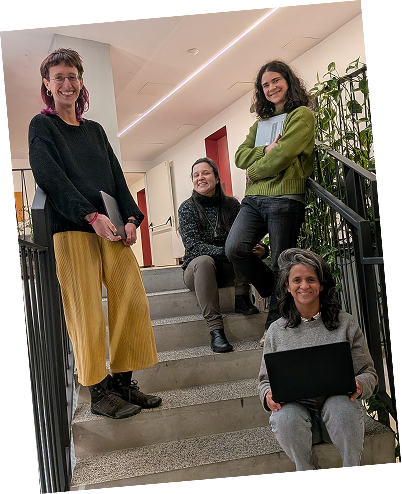
Quilt Studio is born from the intertwined paths of its four founders: an urban researcher, a socio-cultural designer, a constitutional lawyer, and an urban sociologist.
Our experience ranges from academia to local government, including philanthropy and the not-for-profit sector. Together, we integrate expertise in research, ↗ An analytical approach that takes into account the specific territorial, value-based, cultural, and relational context of each setting. , facilitation, design, and law to read contexts, build interventions, and foster alliances among diverse actors.
We operate as an open platform: for each project, we activate collaborations with organizations, collectives, and professionals, building tailor-made teams. This allows us to connect local knowledge, international networks, and specialized skills, adapting methods and languages to specific contexts without compromising quality, rigor, or relational attention. Together, these experiences form the foundation from which Quilt Studio operates.This allows us to connect local knowledge, international networks, and specialized skills, adapting methods and languages to specific contexts without compromising quality, rigor, or relational attention.
Together, these experiences form the foundation from which Quilt Studio operates.

Angela Maria Osorio Méndez
She holds a dual degree in Architecture and a PhD in Urban Studies. She has eight years’ experience in the management of complex projects and funding schemes for third-sector organisations, public bodies and charitable organisations in the fields of mental health, local and community welfare, and cultural spaces. She designs and coordinates support programmes, mentoring schemes and learning systems.

Chiara Basile
She holds a PhD in Urban and Regional Development, and her studies and research were undertaken in Italy, Argentina and Belgium. Since 2019, she has been working on organisational and strategic planning, strategies for change and local development, collaborative processes and skills transfer programs, for various local authorities and charitable organisations. She focuses in particular on universal accessibility, civic innovation and collective learning practices.

She holds an Italian-Belgian PhD in urban sociology. She specialises in gender issues and participatory methodologies. Her work focuses on facilitation, analysis and research, monitoring and evaluation, combining multidisciplinary, educational and artistic expertise.

Postdoctoral researcher in Constitutional Law (Federico II, Naples), with experience at Paris 2, Paris 13 and Antwerp. Author of monographs and research papers on the commons, participatory democracy, cultural policies and Internet law. Project manager and trainer on participatory processes and the commons.
Contacts
If you’d like to collaborate, propose a project or request further information, please email us at info@quiltstudio.org
What We Offer
Our Services
We propose tailor-made services in ↗ A research approach that combines the analysis of a problem with the testing of concrete interventions, actively involving the people concerned in the process. , training, and accompaniment for the transformation of organizations, services, programs, and spaces. We utilize tools and approaches such as:
- ↗ A tool for self-analysis of internal processes, such as gender equality.
- co-design and ↗ The creation of a pilot, experimental version of a product, service, or process, in order to test and improve it before final implementation.
- group facilitation
- strategic planning and design accompaniment
- monitoring and evaluation
- formal and ↗ Learning that takes place through shared structured experiences (role play, theatre, hands-on workshops…). education
All our interventions integrate a cross-cutting attention to gender, ↗ Adapting environments, products, services, and information to people with specific characteristics that put them at risk of exclusion (e.g. gender, disability, language…). and relationship quality.
We work in English, Italian, Spanish, and French, with basic knowledge of German.
Participatory Action Research & Prototyping
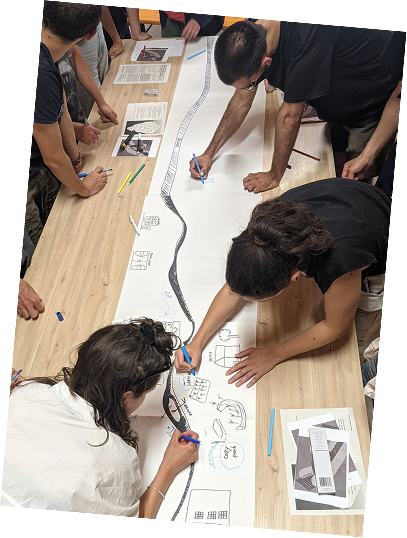
We conduct participatory action research and prototyping to build programs, spaces, and services that respond to contexts and the needs of the people we work with. We combine qualitative, processual, participatory, and action research methods, collaborating with social and IT researchers, operators, service designers, designers, psychologists, and educators to develop integrated solutions adapted to different intervention fields.
Examples of activities:
- co-designing new public services based on community needs
- prototyping civic spaces and collective uses
- field research to inform policies and programs
Training & Collaborative Learning
We design and implement training paths, MOOCs, educational modules, toolkits, workshops, and Communities of Practice for operators, public officials, professionals, and active territorial subjects. We offer accompaniment on addressing diversity, accessibility, and the fight against social and digital stereotypes in service design and the languages we use. We promote and apply participatory and workshop methodologies to address contemporary social challenges, leveraging experience and methodological competencies in both formal and non-formal education.
Examples of activities:
- training paths on participation and democratic governance
- workshops on principles and practices of accessibility and inclusion in services
- creation of operational toolkits for organizations and territorial networks
(Re)activation of Urban Spaces & Territories
We design, develop, and support—on behalf of public entities and civil society organizations—the creation of ideas, actions, and solutions for the community transformation of civic, political, and socio-health spaces, and for the enhancement of broader urban and territorial contexts, using ↗ A design approach or intervention conceived and adapted to the characteristics, needs, and specific context of a given place. intervention methodologies and caring for shared governance processes.
Examples of activities: accompaniment in the reactivation of unused public spaces design of shared management models for urban commons pathways for involving local communities in spatial transformations
Governance Accompaniment
We support non-profit, civil society, and social solidarity economy entities in organizing their governance — from inception through all growth phases — in coherence with their founding values and attentive to internal democracy and diversity, with particular reference to gender equality.
Examples of activities:
definition of participatory decision-making models
revision of organizational structures from an inclusive perspective
accompaniment in the establishment of new organizations
Project Management
We coordinate, manage, and monitor projects and programs we have helped develop, or for which proposing entities seek management support. Our experience in managing complex projects and programs focuses particularly on active participation, welfare service transformation, accessibility implementation, and public policies.
Examples of activities:
- coordination of programs funded by public entities, foundations, and similar subjects
- operational management and monitoring of complex projects
- design and leadership of Communities of Practice
- support for reporting and impact evaluation
Manifesto
Radical Solidarity & Margins
We practice a radical solidarity measured by how we stand alongside those on the margins, assuming shared responsibility to transform the conditions that produce vulnerability.
Interconnection & Ecosystems
We recognize the interconnection of people, organizations, non-humans, and ecosystems: every action is embedded in complex networks of social, ecological, and political relations that we must learn to read and respect.
Context-Sensitive Knowledge
We consider context-sensitive knowledge as fundamental; we adapt tools and responses to specific contexts, rejecting universal solutions that erase differences, histories, and positionalities.
Radical Democracy & Asking Who Is Missing
We work toward the democratization of decision-making processes, always asking who is missing from the table and creating conditions for those with less influence to enter, speak, and take power.
Engaging with Complexity
We choose to engage with complexity and “stay with the trouble”, simplifying only to make it comprehensible, without impoverishing the richness of conflicts, ambivalences, and differences.
Research, Critical Inquiry & Continuous Learning
We begin every pathway with a research and self-evaluation gaze, defending space for critical questions before answers and treating every project as an occasion for shared continuous learning.
Interdisciplinarity & Possible Futures for All
We interweave disciplines, practices, and languages to imagine and build livable futures for all people, where possibilities are not a privilege for few but a common infrastructure.
Socio-Ecological Justice, No Borders & Inclusion
We orient our work toward just socio-ecological transformations, contesting borders that produce exclusion (national, institutional, symbolic) and centering those who experience racialization, gender oppression, ableism, and migratory backgrounds.
Kindness
We cultivate empathy, kindness, and cooperation as political conditions of our action, rejecting competitive models that erode trust, accessibility, and the possibility of thinking together.
Play & Shared Power
We use play and Communities of Practice as methods to learn together, redistribute power, support those who cannot arrive alone, and make transformation a shared, open, and accessible process.
How We Work
Our approach
Our work is based on a collaborative, multidisciplinary, and context-sensitive approach.
We do not operate as individual consultants, but as a working group integrating diverse competencies — research, design, law, facilitation — to read contexts more comprehensively and build more effective responses.
Our mixed-methods approach, informed by feminist situated research methodologies and participatory frameworks, allows us to engage with client realities and their contexts, intercept emerging needs, and translate them into concrete, tailor-made operational programs, tools, and processes.
When accompanying a process, we deploy a plural gaze and shared analytical capacity, enabling us to address complexity without oversimplifying it.
This approach has a direct impact on project quality and continuity:
- we ensure presence and continuity in activity development, even in unforeseen circumstances
- we avoid dependencies on a single figure
- we build more robust processes, as they are collectively designed and verified
In some cases, this entails greater team involvement compared to single-consultant models. This is a conscious choice: investing in collective work to guarantee quality, reliability, and coherence in the processes we accompany.
This approach allows us to work on complex contexts while maintaining methodological rigor, attention to people, and long-term sustainability.
Our Projects
Members’ Experiences
Quilt Studio was founded in 2026, to value and invest in collaborations that we have been carrying out in variable forms for several years.
This portfolio collects a selection of works realized in collaboration by some or all members before and during the birth of Quilt Studio, in dialogue with networks, partner entities, and local and international communities.
We make this layering of experiences visible because it fuels our competencies, methods, and possibilities for future collaboration.
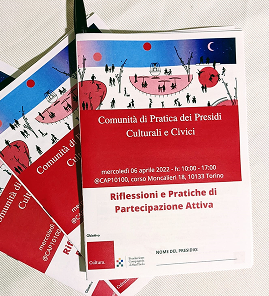
Community of Practice of Civic and Cultural Hubs of the North-West
Location
Piedmont, Liguria, Aosta Valley
Client
Compagnia di San Paolo Foundation – Mission: Foster Active Participation
Period
2021 - 2025
Design and facilitation of a pathway involving managers of over 150 civic aggregation spaces, independent cultural centres, and new cultural centres
Chiara Basile, Angela María Osorio Méndez. Maria Francesca De Tullio was involved in one of the workshops in 2023.
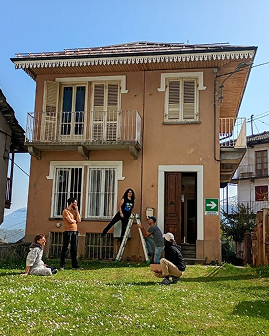
Hacking Property – Casa Biche
Location
Viù (Turin)
Client
Self-produced, with other individuals
Period
2024 – Ongoing
Participatory action research for the development of methodologies and implementation of a pilot project for collective living and horizontal governance management. It addressed the process of creating a group, finding a house, and purchasing an asset to remove it from market dynamics, overcoming the model of individual ownership and experimenting with a de-commodified collective ownership mode.
Angela María Osorio Méndez, Chiara Basile, Maria Francesca De Tullio, Cecilia Nessi
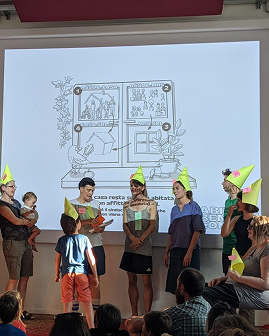
Abitare Bene Comune
Location
Italy – National Scale
Client
Co-founders
Period
2024 – Ongoing
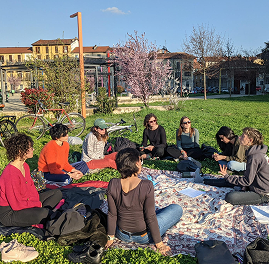
Abitare Bene Comune is an association born from a committee established in 2024 from the “Italy goes Mietshäuser Syndikat” path (promoted by La Foresta), to study and adapt the Mietshäuser Syndikat cooperative model to the Italian context. The goal is to build legal structures that remove homes and spaces from speculation, guaranteeing their collective use in the long term.
Maria Francesca De Tullio, Angela María Osorio Méndez, Chiara Basile
The School of Losing Time
Location
Turin – Local Scale
Client
Co-founders
Period
2019 – Ongoing
The School of Losing Time is an organization that investigates urban culture and city policies, activating dialogues between architecture, visual arts, and civil society. Its projects explore commoning practices and play as tools to rethink the use of time beyond market logic.
Chiara Basile, Angela María Osorio Méndez, Cecilia Nessi
Project Management & Accompaniment for the Grant “Health, Common Effect” 2020-2023 & 2023-2025
Location
Piedmont (mainly the Turin metropolitan area)
Client
Compagnia di San Paolo Foundation – Objective: People; The School of Losing Time Association
Period
First edition: 2020–2023
Second edition: 2023–2025
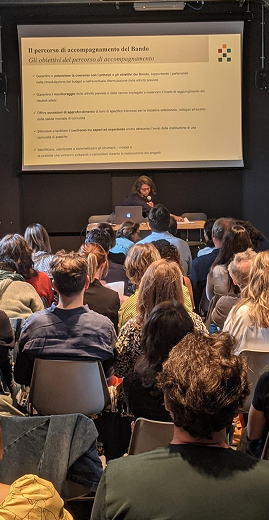
Designing, coordinating, and facilitating the accompaniment pathway for the first two editions of the “Health, Common Effect” grant (2020–2023 and 2023–2025), planning activities, monitoring funded projects, and managing relationships with partnerships, ensuring continuous mentoring.
Designing and animating, for both editions, a Community of Practice among selected projects, with meetings and thematic seminars, and producing reports and synthesis materials that return learnings, methodologies, and shared tools useful for the subjects involved and for the foundation.
Angela María Osorio Méndez (first and second edition), Chiara Basile (first and second edition), Cecilia Nessi (second edition)
Cultural Creative Spaces and Cities
Location
Madrid, Helsinki, Lund, Košice, Timisoara, Region of Skåne, Sant Boi
Funding
Creative Europe
Consortium
European Cultural Foundation, Trans Europe Halls, University of Antwerp. 7 Urban Labs
Period
2018-2021
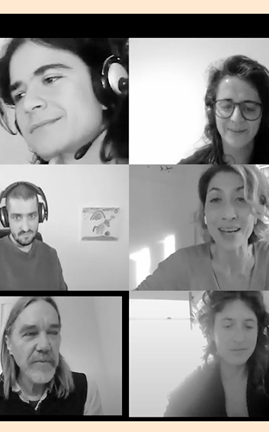
Cultural, Creative Spaces and Cities (CCSC) is a European participatory policy project in the field of culture, co-financed by the European Union’s Creative Europe programme. It brings together cultural and creative spaces, local administrations, and other actors to co-design new public policies, demonstrating how cultural practices and commoning can transform neighbourhoods and cities into more sustainable and liveable places for communities. The project develops and tests co-creation methods through Urban Labs in various European cities, promoting peer exchange, experimentation with new organisational models, and tools to integrate culture and commons into urban policies.
Maria Francesca De Tullio, Angela María Osorio Méndez
L’École des Communs – Governance
Location
Paris
Client
Remix the Commons
Type
Participatory Action Research
Period
2023-2024
Publication
De Tullio, Gorry, Osorio Méndez, Sultan, Let’s make a school of commons. (17 December 2023). Comune-info.
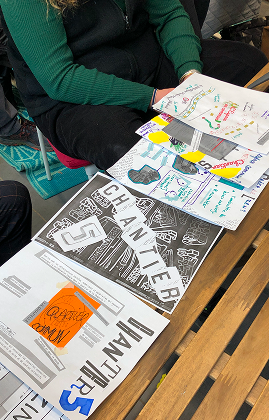
L’École des Communs is a participatory action research project funded by the Fondation Paris Habitat that experiments, in the La Chapelle neighbourhood of Paris, with different ways of enacting governance as a shared practice. The initiative consists of a series of workshops aimed at neighbourhood organisations, working on participation, mutualistic strategies, and governance structure design through the lens of commons and commoning. Within the project, the work involved curation, research, content production, and the facilitation of 5 workshops dedicated to neighbourhood realities.
Angela María Osorio Méndez, Maria Francesca De Tullio. Cecilia Nessi was involved in the final workshop.
Workshop: Debunking the Micropolitics of Relationships
Location
Bolzano
Client
University of Bolzano, Conference By Design or By Disaster 2024
Type
Workshop
Period
2024
Publication
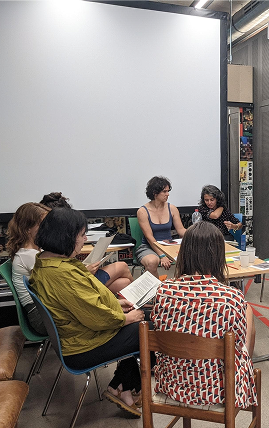
“Debunking the micropolitics of relationships” is a laboratory that investigates power relations in everyday relationships — romantic, professional, political, and even more-than-human — as part of broader systemic structures. The goal is to open a shared space to challenge the idea that relationships are “private matters” and to recognise them instead as political terrains for collective action toward change.
Chiara Basile, Angela María Osorio Méndez, Maria Francesca De Tullio
Facilitation for La Foresta
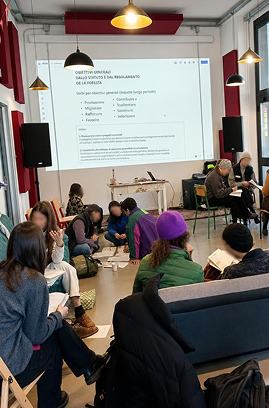
Facilitation pathway supporting La Foresta (Rovereto), a complex ecosystem integrating a physical space, a community of people, and an organisation engaged in political, social, and economic objectives, articulated in a plurality of projects, activities, and forms of volunteering. The facilitation accompanied the group in a self-assessment pathway of medium- and long-term needs and priorities, starting from the association’s founding documents. The work also stimulated reflection on how these vision and mission priorities could translate into the new governance structure being defined.
Angela María Osorio Méndez, Cecilia Nessi